|
DICK LAMPMAN
Young for 40 Years
Helsinki, Finland
January 25, 2007
© Copyright 2007 Hewlett-Packard Development Company, L.P.
All rights reserved. Do not use without written permission from HP.
Good morning. My name is Richard Lampman and I represent HP Labs, the organization responsible for the research side of R&D within Hewlett-Packard.
This is my third trip to Helsinki, and I'm continually impressed with the cutting-edge mobility world you've created and continue to build on.
I hope you enjoyed the video that was running right before I came up. It was a quick look at some of our researchers and projects going on in Labs now. Some of you may think that didn't look much like work, but it is today's work!
As you know, today is all about the digital lifestyle, and user adoption is the key. So, we have to imagine and pilot as we help build the infrastructure to make it all work.
Our 40 years of experience have made us flexible and open to new ideas. Those of us that aren't all that young in body, we make up for it in spirit.
I've watched HP reinvent itself five times in the 30 or so years I've been with the company.
- First we were a test and measurement company.
- Then a computer hardware company;
- That company eventually became a volume printer and PC company.
- Then we turned to enterprise computing;
- And today, in addition to printer, PC and enterprise, we are increasingly becoming a consumer company.
Every time it's been a challenge, but there is not an option to change. At least, not a desirable one.
Since 40 is the anniversary number being celebrated for HP Finland, let me tell you how HP Labs fits into that theme.
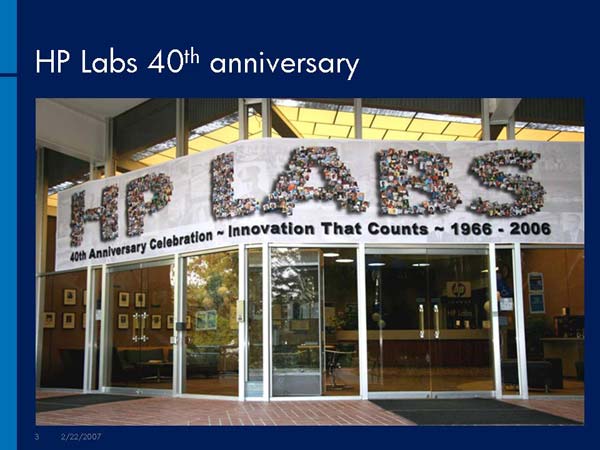
Just a few months ago we also celebrated our 40th anniversary … focusing on a history of innovations that have made a real difference in the technology landscape.
Examples like thermal inkjet technology, telecom management, the first concept of a utility data center and secure Linux.
Each of these technologies is foundational and each core has supported tremendous growth.
We are a pragmatic bunch and like to see our work adopted: the more pervasive, the better.
The arrow to your far right identifies some emerging technologies that may be a bit farther out — both in time and current company strategy — and I'll talk more about those toward the end of my talk.
We study the global technology landscape and make aggressive but careful bets on technology directions while we are locating ourselves advantageously.
HP has lab sites in:
- Palo Alto, California;
- Bristol, England;
- Beijing, China;
- Tokyo, Japan;
- Haifa, Israel;
- Bangalore, India;
- and, since this week, St. Petersburg, Russia.
Within the last several months I've spent time in all these locations — locations chosen for specific reasons and all tightly networked.
These labs allow us:
- access to new markets;
- to spot hot technology communities;
- and, work with top talent throughout the world.
Networks and cutting-edge partners are the core ingredients for a successful 21st century research organization.
- World networks, both human and machine, are getting smarter.
- New cutting-edge partnerships are strengthening.
- And, the next group of targeted services is just on the next set of hills.
Finding just the right area of hills is another matter.
And that's where a central research organization can help. We place bets based on years of experience.
Experience counts — that experience keeps us young and quite flexible, a critical component of our DNA if we're in the game to win.
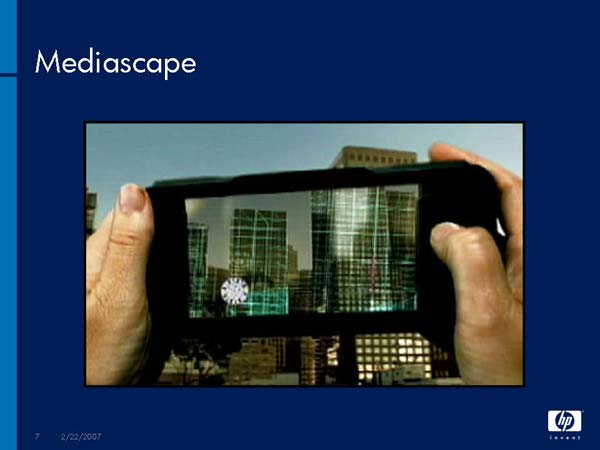
As an example, I offer a short intro to one of our latest projects, a technology we call Mediascape.
As you move about a landscape, you tap into the sights, sounds and interactions that are positioned there for you. It's a rich immersive experience — you react to it, it reacts to you.
Mediascape offers a personalized, context-aware, interactive, multimedia experience.
This is a visionary video — maybe three to four years out. Actually, maybe less than that.
Although there are a couple of things in the video that are not quite here, most of it is.
As many of you in the audience know, GPS assisted tours, followed by location-based media are probably in our immediate future. Location-based games, advertisements, even training.
What will follow that is the use of sensors collecting all kinds of context: location, proximity, speed, orientation, movement, gestures and many other things — even one's heart rate, as I will demonstrate in a minute.
Since we don't really know who's going to be involved in the newest set of targeted services, the next best thing we can do is build the infrastructure that makes it easy for people to create new content.
HP is on the verge of opening a portal to create programs and games in this large and mostly unexplored space.
And what happens for the company that has created the content tool for new up-and-coming talent? We think good things.
Now, just for fun I'm going to take you back to a research version — not a polished video like you saw earlier, but real researchers and designers actually developing a game — real field work.
The group that designed it called it "Ere Be Dragons" — an interesting name. Map makers in the early days of exploration wrote at the margins of their maps to hint at unknown, uncharted dangers and in this terraforming game, that's part of the challenge.
The way the game works is that one creates land by walking over an uncharted area, and the land has a "goodness" quality based on whether you are maintaining a healthy heart rate or not.
If your heart is too slow, the land you discover becomes desert, too fast and it becomes burnt, useless forest. Keep your heart rate in a healthy exercise zone and it is lush forest and gardens.
You can also capture another's land by walking across it — but only if your heart rate remains at a healthy pace.
Talk about a different exercise program!
We are beginning to look at technology from the top down — from the user perspective — as well as from the infrastructure layers.
Researchers within Labs have created several Mediascapes:
- one for school children where they could pretend to be wild animals on the Savannah,
- another at Yosemite National Park in California
- and yet another at the Tower of London .. where visitors could assist with the capture of escaping prisoners.
Interactive and immersive are today's hot technology areas for consumers and for many enterprises.
Immersive screens give one a unique field of view and a very different experience.
Some of the immersive experiences zooming to the forefront are large displays done with multiple projectors for:
- digital cinema,
- high-end gaming
- and business collaboration.
No one knows better than this audience that the communications network has been through several big transformations — converging wired networks with digital mobile phones and now to media streaming and interactive services.
HP Labs has played a lead role in creating secure streaming media — something we were told could not be done.
HP Labs work in media security was incorporated in the JPEG-2000 Security standard, which became an official ISO/IEC standard in July of 2006.
Labs researchers have worked with some of the largest mobile operators in the world to understand what drives them, so we could develop technology for the needs that they were ultimately going to have.
We're developing an OpenStream architecture that will eventually stream multimedia across different devices on different networks. It's obviously a big undertaking but we have made considerable progress and have valuable IP in this area.
Now, let's turn to information management, or how we gather and organize the digital data overload — as we don't believe it's going to slow down anytime soon.
In HP alone, we already have around 180 terabytes of raw data in our many data warehouses, with only one-third to one-half of that considered "usable."
It would be my guess that every major organization in every industry is facing the same challenge.
The communications industry is a perfect example.
Increasingly cell phones are becoming converged devices — part mobile phone, part music and video player, and part Internet device.
And as you know, both enterprise and consumer customers increasingly want instant visibility into their transactions and accounts.
The traditional telecommunications data management infrastructure is inadequate for meeting these growing demands from subscribers.
The information infrastructure needs an overhaul.
HP Labs is in the thick of figuring out how to make data management much more responsive and useful — for network operators and other enterprises.
Our Advanced Database Program focuses on developing scalable databases and data warehouses for enterprises, using massively parallel processing.
The program's current focus is on determining how to scale database engines so that they can accommodate very large amounts of data and answer many very complex queries simultaneously.
We're also looking at whether these new parallel databases can automatically monitor certain conditions and activities, such as detecting fraud or sending marketing messages to a select group of subscribers whose service choices indicate they might be interested in a particular service.
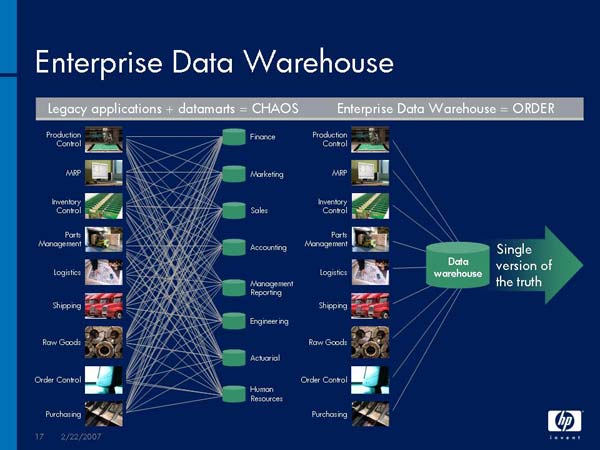
Here you see the framework for our work in active data warehousing for network operators, where we have a hierarchy of IT containing the kind of information that's useful for customer support and marketing.
It also provides the enterprise data warehouse that stores all of the historical data and is used for trending analysis.
All of these are linked to form a data warehouse, potentially of petabyte size — more than 1,000 terabytes of data.
A lot of the advanced database program research is being done at HP Labs China.
Talk about a challenge: China Mobile, the country's largest mobile provider, has about 300 million subscribers and is expected to see a 10-fold increase in volume and traffic over the next three to five years.
Researchers there are working with two Chinese telecommunications to help them integrate operations geographically.
We are helping operators transition to third-generation services by enabling much more flexibility in the deployment of payment plans.
This is an important area of research being used in parallel as HP builds its own enterprise data warehouse.
As I mentioned earlier, HP also has an information management challenge — but we are tackling it.
We are building what will be one of the world's largest enterprise data warehouses.
It's based on massively parallel processing and when it's completed in a couple of years, it is expected to have up to 700 terabytes of data and be capable of supporting 50,000 application users and 350,000 reports.
We started this three-year overhaul of the company's IT organization last spring. We're consolidating 85 data centers into six and reducing applications from 5,000 to 1,500. The current focus is on improved management and monitoring tools.
As we build, test and harden the system, we are also entering the five billion dollar a year data warehousing market with a system called Neoview.
HP Labs is providing new technology for HP Neoview — a technology that has waiting customers, one of whom was impressed by the 13-times faster answers they received when data-analysis workloads were run.
Information management is going to keep our industry busy for awhile … and, in fact, HP Labs is actually working on several technologies to help with the gathering and organization of digital data … one is the Semantic Web.
We all know that there are enormous amounts of useful information scattered throughout organizations but many people don't know it exists or can't easily get to it.
Part of the problem is that data is held hostage to the application used to create it. So, even if you know the information you want is out there, to have a chance at finding it directly you need to at least know what application it was written in.
But many times you don't even know the data is out there. Or maybe you know it's out there, but you don't know where. Or you know where but you can't access that database.
Here's all of this useful information on your intranet, ripe for the picking, but you can't get to it. So what do you usually end up doing? You send a bunch of e-mails to your work colleagues, asking them if they have the information that you need or know how to get it.
Now, an intranet is certainly a big help to an enterprise, and while it does a lot of things well, integrating information that's stored on it isn't one of them.
However, that will change over the next several years, as technologies that are being created to build the next generation of the Web — called the Semantic Web — get applied to a company's intranet.
The result will be a global database, instead of what we have today, which is a global library.
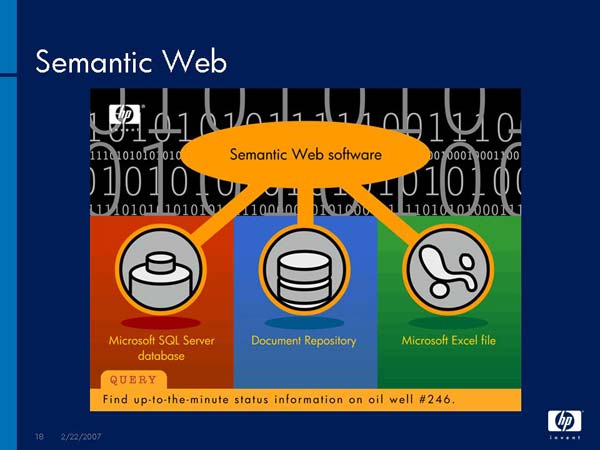
The Semantic Web is an extension of the current Web that adds meaning to web content so that computers can "understand" the relationships between different data and can infer and make decisions about what you're looking for.
The Semantic Web will let you ask more complex questions and get more relevant and meaningful answers than you get today from typing words or phrases into a search engine and then plowing through a list of web pages that contain those words or phrases.
Semantic Web technologies allow you to define each type of data and how it relates to other data.
In the Semantic Web, data is tagged in a way that lets it be found no matter what applications it was written in and no matter what file it is stored in.
HP Labs, which is deeply involved with the creation of the Semantic Web, already is applying the available technologies to help enterprise customers integrate information on their intranets.
We've worked with an oil company to apply Semantic Web technologies to get up-to-the-minute performance data on a particular oil well, such as financial data, pumping information, oil quality information and geological information — data that sits in different databases in different computers.
We've worked with a global financial services company to help it define roles and relationships between particular jobs in particular countries — countries that have different regulations regarding who can see what kind of information.
In this case, we're using Semantic Web technologies so that one day, when someone new joins the company, that person will automatically get access to precisely the proper applications and information permitted for that job in that country.
It's worth mentioning that HP is deeply involved in developing the Semantic Web. We're a major participant in the W3C organization to evolve the Web where the Semantic Web is a major initiative.
HP Labs Bristol researchers have helped develop several key Semantic Web standards and technologies. They developed Jena, the most popular Semantic Web application tool kit.
The Semantic Web is going to be real in less than five years, and the technologies that are making it possible are useful to enterprise companies today.
Although most of the projects in our labs are tied directly to our current business strategies, we also do basic research in longer-term high potential areas that we believe will provide future technology growth paths for HP.
I'll share three of those areas with you today. The first is in the communications area, something we call harvesting knowledge.
The second is a type of near-field memory device, and the third is our world-renowned quantum computing program.
This area of research revolves around uncovering natural "communities of interest" that can be tapped to make better decisions and unleash knowledge throughout a corporation.
It's achieved through the evaluation of patterns inherently derived from e-mail interactions and public or internal content repositories, such as those for authoring and referencing.
Researchers have developed an algorithm that measures the prominence of thousands of e-mail messages by how they traveled within certain HP divisions.
What they discovered was that day-to-day work was often accomplished by self-selected teams of people who don't show up as a group on a formal organization chart.
The theory is that members of the groups actually made up de facto teams of experts whose business decisions would outperform those of the formal experts.
These technologies are currently being put into practice.
What would you do if you could put a lot of memory into a little spot? If you had a tiny little device, smaller than a grain of rice that could store a half a megabyte of memory?
Not only store, but actually read and write to that spot at 10 megabits per second. And, by the way, that will be increasing very quickly to 40 megabits.
The Memory Spot chip has an onboard memory, onboard antenna and onboard processing capabilities.
It has a very close range of millimeters for contact to the read/write device.
In summary, you have a technology that gives you:
- quick access to large memory
- in something small enough to be embedded
- on a device that can store any digital content.
That set up allows for some very interesting applications: photos, documents, passports, hospital wristbands — even medicine bottles with directions embedded from your doctor or pharmacist.
The price to the customer could be anywhere from 10 cents to 10 dollars. There are many variables at play here, the most important being the business model. But we believe that with all the many factors involved, we could price the chips between $1 and $2 completely packaged. We'll see how it goes.
Now, on to quantum research.
For around 10 years, HP Labs has supported a quantum science research program.
Our current program, designed to integrate electrons, photons and atoms adds capabilities to push the limits of IT advancement.
Research into molecular-scale electronics is inspired by the realization that the fundamental limits to the power efficiency of computation — as described by Richard Feynman and others — lie as much as a factor of "one billion" beyond the presently known capabilities of silicon integrated circuits.
Our team has come up with a way to use molecule-sized components to do commuting, and we have demonstrated laboratory prototypes for memory and logic circuits that are about 10 years ahead of the industry roadmap for semiconductors.
We anticipate that the structures we are now building will be integrated into systems with trillions of components within the next few decades.
In fact, our lab is considered by many to be the world leader in this nanometer-device-building area.
Within the electron/logic space, we recently we announced a field-programmable nanowire interconnect — or FPNI for short — that could lead to the creation of field-programmable gate arrays that have a logic density eight times higher and use less energy for a given computation than present FPGAs, without having to shrink the transistors in the circuits.
FPNI can help to extend the CMOS roadmap: a "keep it healthy, keep it going" invention that could easily be used in current fabrication facilities.
Now, let's take a look at photons — now being used in the security area, a technology that we anticipate will show up for your use within just a few years.
We're using quantum physics to create unbreakable security for widespread e-commerce.
We know that the conventional means of securing e-commerce transactions could well be broken one day, either by a clever mathematician developing a new algorithm, or by the eventual creation of a quantum computer, which can effortlessly break the mathematical codes that secure modern information systems and networks.
Our researchers can take advantage of the laws of quantum physics — which state that you can't observe a quantum system without changing its state and thereby unavoidably leaving evidence that you looked at it.
They've found a way to distribute completely secure and disposable codes that two parties — say you and your bank — can use to identify each other and encrypt messages.
These one-time pads of code are decipherable by only the two parties authorized to use them.
For long distance communication, one-time pads are created and distributed using photons pulsed over optical telecommunication networks — a process called quantum key distribution.
Because it's quantum distribution, a hacker can't go undetected in his attempts to grab the code because he ends up leaving evidence of his efforts — evidence you and your bank can detect. And when you do, you can toss those tainted codes and keep only the secure ones. The hacker ends up with bits of code that are useless.
While worldwide there is a lot of research underway into creating secure quantum networks between enterprises and inside them, HP Labs is working to bring quantum security to the end user.
We're researching inexpensive and short-range technology that would put quantum security in every mobile device you own, so that you could securely use your handheld device at the cash machine or to turn on your computer in your office.
A couple of years ago consumer quantum key distribution was just an idea. Now it works in our laboratory in Bristol.
I hope you have enjoyed this glimpse into our labs. I have enjoyed sharing it with you.
As a 21st century research organization, we are very aware that we need the world's top input and talent.
We need to be open to new ideas — then focus our research toward creating powerful technology our customers can use today, tomorrow and in the future.
We need to continue our engagements with cutting-edge customers.
This collaborative process, combined with advanced scientific capabilities, enables us to deliver leadership technologies.
HP at its heart, is a technology research-driven company and we believe that in today's world that's becoming more and more unique.
Thank you for your attention.
|