|
GILLES BOUCHARD
Keynote address
AMR Supply Chain Executive Conference
Scottsdale, Arizona
June 1, 2006
© Copyright 2006 Hewlett-Packard Development Company, L.P
All rights reserved. Do not use without written permission from HP.
Good morning, everybody. It's a great pleasure and a great honor and a great challenge to open this conference.
Every year, HP ships more than 50 million printers, 30 million PCs, 10 million servers, millions of other products. This is a massive challenge from a supply chain point-of-view, from procurement to manufacturing, to distribution and to end customers.
We must consider how to responsibly dispose of these products at their end-of life. Also, we must be aware that these products are often made by partners and suppliers.
How do we assure that what we do is socially and environmentally responsible? One advantage we have is that the people at HP are passionate about this. I want to share some of the stories I heard from them as I was preparing for this talk today. I won't have time to talk about everything we do. We're a big company and we do a lot. I'll share some interesting stories. For those of you who are more interested in details, we publish a 100-page report filled with data and charts, which is available on the web and you can download from there.
Let me start with what I'm going to cover. I'm going to start by reviewing the past, just to highlight how much everything we do and how much our thinking even today is influenced by the core values and the origins of the company.
Then, for the present day, I'm going to cover three topics: what we do about recycling; what we do in the design and R&D phase, to improve the environmental footprint of our products and also the Electronic Industry Code of Conduct which is all about the social responsibility to our suppliers.
Moving on to the future and I'll talk about three technologies, which I think will have a tremendous impact on the environment. These are not science fiction. They are all real, they exist today, some of them are very new, but available. First, we have a very new and revolutionary approach to video-conferencing which will have a really big impact on travel. Second, our digital printing which really helps remove a lot of waste through paper usage. Third, cooling and power consumption in data centers.
So let me start with the past. Rather than give you a big history lesson, I'll show you a short video. A few months ago, we created a video looking back at the origins of the company and the values of Bill [Hewlett] and Dave [Packard] - our founders. I will just share a very short excerpt from this video that is relevant to what we are talking about it today.
[Video plays]
What was striking about this video clip is that some of the things we take for granted today were quite revolutionary in the 1940s and 1950s. Thinking back to what we heard earlier, a lot of the things we think are difficult or unusual today might well seem like common knowledge and common wisdom years from now.
I want to highlight a few key items on this timeline. In 1940 HP was a new company, and had three employees and we made our first charitable contribution of $5 to local charities. 1957 was a very important date when the company went public. When we went public we published a set of seven company objectives, and one of them was citizenship, which was very new at the time. We started our recycling program in 1989 and we took that to a whole different dimension in 1992, when we started a comprehensive recycling program for LaserJet cartridges. We extended it in 1997 to inkjet cartridges. In 2002, an important milestone was the first Supply Chain Code of Conduct for suppliers. Then in 2007 - this will be a big landmark for us - we will have recycled one billion pounds of electronic goods.
So let's move to the present. A few words about HP today. It is a big, growing company, we've passed the 90 billion dollar mark, we're growing 5 percent, 8 percent in constant currency. We're a leader in just about every market that we play in. We have a large geographical footprint. We operate in 178 countries, with 150,000 employees, a lot of partners, 145,000 sales partners. We have a lot of suppliers. To give you an idea, everything we buy from services to logistics adds up to over $67 billion. Parts and products alone are almost $53 billion. So we have a major impact on the supply base, which I'll come back to later. Next, I'll focus on creativity. We spend $3.5 billion annually on R&D and generate 11 patents a day. I'll show you some examples of this innovation that is applied to help the environment.
So why do we care about these environmental issues? It's not just because of our values and our history. It matters to customers more and more. Last year of all large requests for quotation from customers - RFQs - more than $5 billion worldwide had some sort of requirement for Social and Environmental Responsibility. In Europe alone, of the large RFQs, about 60 percent now have such requirements. So large customers do care. As you heard, distributors do care as well. The governments care a lot. There's a lot of regulation. You've heard of WEEE (Waste Electrical and Electronic Equipment) and RoHS (Restriction of Use of Certain Hazardous Substances). Employees care. Our employees have a passion about this - in fact a lot of the initiatives that I'll share with you today, were not some big corporate initiative first. They were started from the ground up, by passionate employees. Suppliers really care. In fact, I was in India last week and one of the biggest concerns I heard from suppliers - which is kind of new - is their concern about their ability to get material. The scarcity of raw material has become a real issue. It's making these big mountains of electronic waste out there look like a nice source to mine for material. And then investors care as well. Socially responsible investors have a lot of concerns.
How do we approach environmental issues? Well, we focus on the 3 Rs: "Reduce," make the product smaller, use less energy, smaller packaging; "Reuse" to make the product life-cycle last as long as possible; and "Recycle" at the end of life.
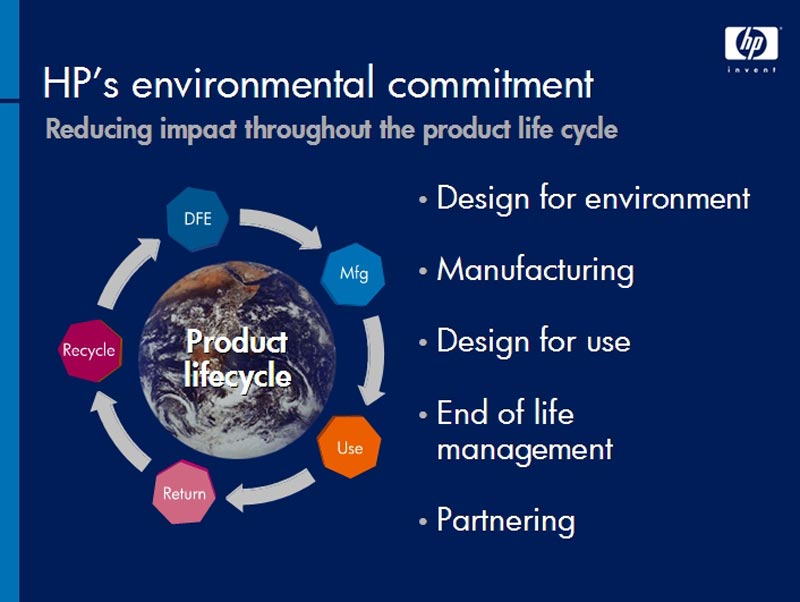
We think it is important to consider the whole life cycle of the product. We start with design, which is what we do in the labs. Then we move to manufacturing, where we are ISO14001 compliant and have, for example, internal controls to reduce carbon dioxide emissions in our facilities by 18 percent this year. Then we move to use, making the products less wasteful, more energy efficient and making products more easy to return and recycle.
I'm going to pick one example of the product lifecycle to get the point across. One that always gets HP people very frustrated is printer ink supplies. You might notice that the remanufacturers and re-fillers of printer supplies in some countries have been very successful as positioning themselves as "green" because they extend the life of the product. If you look at the cycle, it is really the opposite, because at every stage of the cycle starting with their manufacturing process, about 20 percent of the supplies end up being wasted and end up going to landfill. If you go though our recycling process nothing ends up in landfill. So it's very important to effectively recycle the product.
Now, if you have any doubt, there's a lot of product out there. I want to do a quick show of hands. Will everybody who thinks they have some sort of electronic product somewhere in their house that's not being used, raise your hand.
[99 percent of audience raises hand. Laughter]
You get the point.
Let me share a few numbers with you. We did a study a few months ago in Europe and I'll let you guess in a second - what is the main motivation for the people to recycle electronic junk? Answer: It's when they get a new car. Now why is that? Because they need to make room in the garage. If you get a new car, then you put it in your garage.
[Laughter]
This is a new kind of market research. We estimate that more than 60 million PCs every year in the U.S. alone either get discarded or traded in. The Environmental Protection Agency estimates that two million tons of junk end up in landfills every year, and worse yet, another watchdog organization estimates about 80 percent of the junk ends up in landfill in Third World countries.
So what do we see from an industry perspective? Last year we recycled more than 140 million pounds of material, that grew almost 20 percent from the previous year, on our way to our billion pound mark, so a lot of stuff out there waiting to come back and a lot of stuff coming back.
We have two recycling plants in the U.S. - one in Memphis, Tennessee, and one in Sacramento, California and I want to show you a video of what we do in California.
» View recycling video
I think this video speaks for itself. When I talk about the passion of people, about the sense of purpose and contribution that David Packard mentioned, it comes across very strongly.
A couple of other points - this is about the recycling process, but it doesn't cover all the ways we get the stuff back. It's often regulated by governments in Europe through the WEEE program. As an industry we've a very big role to play here. At issue is market dynamics, efficiency and cost reduction. In a lot of countries in Europe recycling is managed by government monopolies and it is very expensive. I'll give you an example. In Germany we started with one supplier, with one monopoly, and working with other vendors we wanted to create competition and within six months the cost of recycling a pound of junk was reduced by a factor of five. It is now two to three times cheaper in this country than some of the countries that have been doing it for longer.
The second point is the company we partner with in Roseville for recycling is actually a mining company. Interestingly the amounts of precious metal that we get out of recycled PCs is higher than the amount of precious metals they get from the raw earth from their mines, about 50 or 60 percent higher.
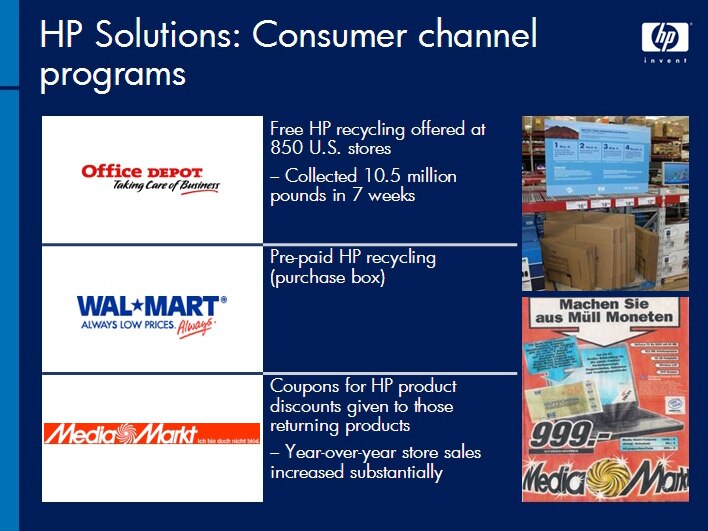
Now, in terms of getting the stuff back, we are also experimenting with several programs. I want to give you a few examples. Last year we started a program with Office Depot. In a seven week period people could bring back any electronic waste for recycling. In those seven weeks we collected ten million pounds. Remember in the video they mentioned we recycle four million pounds a month at our facility, so it's almost twice that run rate from just one retailer.
We also mentioned the HP.com web site where you can go and order some boxes online for recycling products. We're experimenting with a program with Wal-Mart and Sam's Club to include pre-paid boxes for return of electronic waste.
And in Germany there are some very interesting pilots where we are going to give people coupons to buy new HP products when they return old products. We ran this for a week several times with Media-Markt, a German retailer, and we saw sales increase by a factor of three to seven times over the same period a year ago.
This is another area where I think the right thing to do is a smart thing to do. I want to highlight that not all electronic junk is created equal. Some of those returned goods are quite valuable. Like PCs, for example, which are more valuable because of their precious metals. Not so with monitors, white goods, and so on, which are less valuable.
Let's move on to the development side with a couple of examples. The first one is a scanner which we launched in 2003 which uses recycled material for the carriage inside it. 25 percent of it comes from our own facilities and 75 percent from bottles. It's a very interesting experiment for us. We had to test the whole process, to ensure we can use the same moulds. When we started, the manufacturing cost was actually higher. Now that raw material prices are going up, it is actually cheaper to reuse materials, so it is now cost competitive.
Another example is packaging. Here's a whole generation of cameras and the reduction in size of the complete packaged product. You can see the numbers have been reduced. There's obviously great savings from an environmental impact point of view and great savings from a freight cost point of view.
To give you an example between the 2003 and the 2005 product, the freight costs went down by 35 percent, and in 2005 you see another 35 percent saving.
Let's move to social responsibility. The Electronic Industry Code of Conduct has to do with what we require from our suppliers from the point of view of health and safety, human rights, labor rights, environmental issues and ethics.
We issued our own code in 2002, but we quickly realized doing it on our own wasn't going to be very effective, so we re-launched an industry-wide effort. You can see all the members that joined in 2004 and 2005. An industry-wide code of conduct has been enforced since 2005.
Let me show you how the process works. It starts with corporate policy - like the one we've had since 1957. This evolves over time. Then we issued a code of conduct. Next, suppliers have to fill out self-assessment forms, they get audited on those results, and they take corrective actions. So that's where we are today.
How often do we find problems? We find lots of problems. They are all detailed in the statistics in that Global Citizenship Report I showed you earlier. But this takes a lot of work, it needs a lot of attention and a lot of joint work with suppliers to improve them.
So this is where we have been and where we are today. We don't believe this is the endpoint. The endpoint is this final step - capability building - the capability to build a self-improving system. This is very much the same approach that we went through with quality a few years back. We moved from the inspection of quality issues to continuous process improvement. It is exactly what we're trying to do with the supplier base here.
I am proud to announce today that we've launched a new HP program, specifically targeted at this issue. It is called FISI: The Focused Improvement Supplier Initiative. It went out on the wire today. It's focused on China, and it is focused on three things: targeted training for suppliers; improving best practices among suppliers, and tracking a set of business practices - the business impact of improvements on productivity, workers and the environment.
We are very excited about this. We kicked it off last month with 33 companies. It's a one-year long training program. HP is not present when the program is run. We created a program to train the suppliers to be self-sustaining in the industry. We started with 33 suppliers, in fact 10 more could not get in, we were full.
All right, let's look into the future now.
Let's start with Halo. Halo is a revolutionary approach to video conferencing. You have to experience it yourself. It creates a real life impression - you feel like you are reaching across the desk to someone else. We launched point-to-point Halo earlier this year, between two rooms, and just yesterday we launched multi-point Halo which has up to four rooms around the world seamlessly video conferencing. Let's roll the next video please.
» View Halo video
It's amazing technology and I encourage you to test it for yourself. I've yet to meet a CEO who's seen this and didn't get excited, so here's your chance to be a hero at your company. It's pretty amazing.
Let me move on to the next example. Digital printing.
Twenty-seven trillion pages of paper get printed every year. That is three to four trillion trees. What is digital printing all about?
The traditional press in the picture on the left is designed to make a lot of something which is all the same. Once you've design printed material, you must plan for long set-up times and you then print a lot of it, which you store for a long time and much of it gets discarded at the end because it become obsolete. This contrasts with HP's Indigo Digital Printing. Indigo is print on demand. You print when you need it and each page can be different, so you can target your printed material to the end user. This has tremendous potential to avoid wasted paper.
Let me give you a quick example of a customer - a company called Growmark, which sells seeds to about a quarter-million farmers. Their traditional way of doing business is to publish big fat catalogues and send them to everybody and keep a lot of them in stock. After working with us they now publish dozens of small 20-page catalogues that go to all of the target sub-segments of the market. No more waste. Print on demand. It reduces their paper consumption by 80 percent, going to 90 percent next year. And guess what - their sales have improved because now they are doing target marketing instead of sending these big catalogues to everybody.
The last example is data centers. You know what data centers are, they are big air conditioned raised-floor rooms. They have all the computers, servers, storage network equipment to run IT. They are very power-hungry and getting more and more so as the density of the computing increases and blade servers and racks are introduced. Half the cost of running a data center today is power consumption, and of this power budget half is to actually power the equipment and half is to cool it. The energy to power a data center is about what it takes to power 2,000 homes. No one knows how many data centers there are in the world. A very conservative estimate is 3,000 - we think that it takes about six nuclear power plants just to power all these data centers. There's a lot of wasted energy. When you walk through a data center, some parts will be very hot and some parts will be very cold. HP Labs has developed technologies that we think can reduce this by about 50 percent.
So how does it work? There are two steps. One is what we call the static step. It's basically modeling, an optimization of the location of elements in the data center in terms of the air conditioning system. This saves about 25 percent of the power. The next step, which is still experimental, is what we call dynamic cooling and involves thousands of sensors throughout the data center. We then use the mapping, the thermal map from the model, to dynamically drive all the air conditioning machines to optimize second-by-second cooling in the data center. In a couple of our data centers we see a 50 percent to 60 percent reduction in power. We're very excited by this. You might have heard that HP is consolidating all its data centers from 85 to six, and this solution will be installed in those new centers.
To close, a couple of points. When we talked about this as a journey we've come a long way since the 1940s and 1950s. We've got a long way to go, there's no question about it. We are very proud of the awards we got, but we're also very conscious about the fact that we're only beginning to scratch the surface.
One thing that I'm excited about is that the computer industry has always been defined by innovation and creativity. It's exciting to see this industry applying its creativity to solving some of those planet-wide problems.
The last point I want to make is that while this is a journey, it's not a journey one can take alone. Consumers, our customers, enterprises, governments, engineers - no one can get too far out on the edge. I was looking for a sports analogy to explain this and perhaps because I'm from France, I'm not too good at baseball or basketball, so I've decided to discuss cycling - the race of the Tour de France. You're not going to win the Tour de France by riding in the back of the pack, and you cannot win by breaking away by yourself ahead of the pack, where you expend too much energy and eventually get caught. The way you win is to break away with the strongest leader and work together, and that is exactly what we want to do. I hope I've shown you if we do that, there is a lot of strong business that comes along with it and this is what it takes to do well while doing good.
Thank you.
|